Kathy H.
Never Let Me GoKathy H. is a carer whose professional skill lies not only in helping donors recover but in sensing when they need comfort, company, frankness, or space. Her nearly twelve years in the role bring her back into close relation with Ruth and Tommy, while the approaching end of her work prompts her to reconsider how Hailsham shaped the lives they shared. In her account, care is both practical labor and a fragile way of remaining connected in a world organized around donation and completion.
Identity and Background
At thirty-one, Kathy has worked as a carer for more than eleven years. Her current assignment is expected to continue for another eight months, through the end of the year, bringing her service to almost exactly twelve years. She is careful not to present that record as proof that she is exceptional: some capable carers are stopped after two or three years, while one carer she remembers continued for fourteen despite being, in her view, ineffective. Still, Kathy knows that her own work has pleased those responsible for it, and that she has generally been satisfied with what she has done.
Her donors tend to recover better than expected, with impressive recovery times and few classified as agitated, even before a fourth donation. Kathy takes particular pride in their calm, and describes developing an instinct for how to respond to each person: when to stay and comfort, when to leave a donor alone, when to listen, and when to offer blunt encouragement. The skill she values is therefore a form of judgment exercised in small, changing encounters rather than a single fixed manner of care.
Kathy’s Hailsham background affects how others view her work. Some carers resent her bedsit, her car, and especially her ability to choose which donors she looks after. They may assume that she selects her own kind, meaning people from Hailsham or other privileged estates, and that her good record follows from this advantage. Kathy acknowledges that she has been allowed to choose for only the last six of her nearly twelve years, and that she has also cared for donors raised in many different places. She nevertheless accepts that choosing familiar people is natural: carers have finite patience and energy, and sustaining their work depends on continuing to feel for the people in their care.
Work, Solitude, and Its Costs
For Kathy, care has mostly suited her and may even have brought out her best qualities. She understands, however, that the work can overwhelm people who begin it with good intentions. A donor may complete unexpectedly, even after a second donation when complications were not anticipated. Reassurance from nurses and a letter praising the carer’s efforts cannot immediately undo the demoralization that follows. Kathy sees Laura as someone who never learned to absorb such losses in the way some carers do.
The role also replaces the crowded social life of growing up with long stretches alone. Carers drive between centres and hospitals, sleep away from home, and often have neither time nor energy for a proper conversation when they encounter someone they know. Travel, long hours, and broken sleep gradually show in posture, gaze, movement, and speech. Kathy does not claim to have escaped these effects, but says she has learned to live with them. She is particularly critical of carers who shrink in hospitals, cannot speak up to medical staff for their donors, and later blame themselves when something goes wrong. Kathy tries not to make a nuisance of herself, but has learned to make her voice heard when necessary; even after a bad outcome, she can take some comfort in believing she did what she could.
Solitude is not simply a burden for her. She has come to enjoy driving alone in her small car, with the roads, grey sky, and her daydreams for company, and she sometimes passes spare minutes looking in shop windows. In her bedsit she has four desk lamps of the same design but different colours, with ribbed, bendable necks; she enjoys comparing them with similar lamps displayed in shops without intending to buy one. These modest routines show how she has made a private rhythm within a demanding, mobile working life. She still looks forward to more companionship after her assignment ends, but does not regard solitude as wholly empty.
An unexpected meeting with Laura at a service-station car park exposes the distance that work can create. They had not met since the Cottages seven years earlier, and Kathy briefly considers walking past rather than interrupting her daydreaming. Seeing Laura sitting vacantly in a parked car, Kathy recognizes the signs of a carer worn down by the occupation she has just described. The moment is uncomfortable partly because Laura had once been one of her closest friends and partly because Kathy suspects what she will find if she stops to reconnect.
Choosing Donors and Renewing Old Ties
Kathy’s ability to choose donors has allowed her to seek out people from her past, especially people from Hailsham. Ruth was only the third or fourth donor Kathy chose. Ruth already had another carer, so asking to take her on required some nerve. When Kathy saw her again at the recovery centre in Dover, their differences did not disappear, but seemed less important beside their shared childhood and the memories they possessed that others did not. That reunion helped Kathy stop resisting the pull of Hailsham and begin looking for donors with whom she had a deeper history.
The connection matters to Kathy because familiarity changes the experience of care. She says the work becomes harder without a deeper link to the donor, and that she could not have continued for so long if she had ceased to feel for them. But the supply of donors she remembers is dwindling, so in practice she has lately exercised her choice less often. Her long tenure is thus sustained by personal attachment even as time and the donation system steadily reduce the number of people with whom she can renew it.
Kathy’s attention to Hailsham also comes from encounters with donors who need to remember it. During her third year as a carer, a donor had just undergone a badly managed third donation and could hardly breathe. When Kathy mentioned Hailsham, he responded that it must have been beautiful. The next morning, while she tried to distract him with conversation, he named a place in Dorset where he had grown up and grimaced in a way that showed how much he did not want to be reminded of it. Kathy understood that he wanted to hear about Hailsham instead. The exchange deepened her sense that remembering the place could be a form of comfort, even for someone who had never lived there.
Ruth, Tommy, and Care as a Promise
Kathy’s renewed closeness with Ruth includes distrust and an apology. On a drive together, Ruth asks Kathy to forgive her, beginning with the way she had lied about Kathy’s urges in the past. The trip changes their relationship: a few days later, Kathy realizes that their guardedness and suspicion have evaporated. During a period when Ruth’s health is relatively steady, Kathy visits in the evenings with biscuits and mineral water. They sit together at the window, watching the sun go down over the roofs and talking about Hailsham, the Cottages, and whatever else comes to mind. Kathy remembers this late period with sadness because Ruth is gone, but also with gratitude for the closeness they regained.
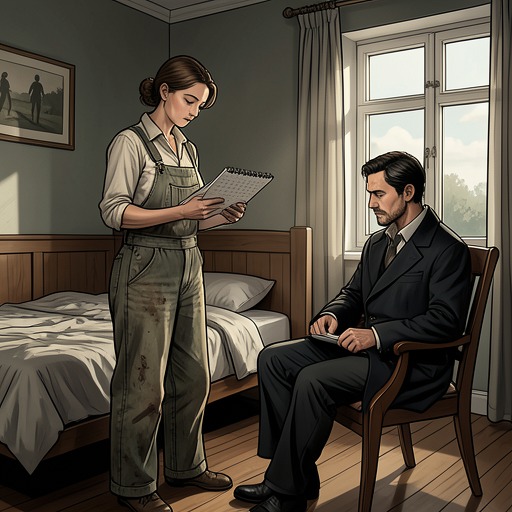
One subject remains largely unspoken between them: Ruth’s wish that Kathy become Tommy’s carer. Ruth returns to the idea in indirect prompts, suggesting that Kathy could arrange it if she wanted. Kathy says she is thinking about it and that arranging such a change is not simple, but understands that the question remains important to Ruth. Three days after Ruth’s second donation, Kathy is allowed to visit her in the early hours of the morning. The doctors, coordinator, and nurses behave as though they do not expect Ruth to survive. Kathy holds Ruth’s hand beside the hospital bed, staying as long as she is permitted—perhaps three hours or more—and squeezes it when pain makes Ruth twist away.
For most of the visit Ruth is too deep in pain for Kathy to reach her. Then, for a few seconds, Ruth looks directly at her and seems to recognize her. Kathy promises that she will become Tommy’s carer as soon as she can. She cannot know for certain whether Ruth understands, but believes that Ruth may have read the promise in her expression. In retrospect, Kathy also suspects Ruth understood before she did that she and Tommy would try to be together. The promise makes care more than a professional assignment: it carries Ruth’s wish into Kathy’s relationship with Tommy.
Ending the Work and Holding on to Memory
Kathy expects to welcome the chance to stop caring, rest, and remember when the year ends. Her desire to put old memories in order begins with what happened between herself, Ruth, and Tommy after they left Hailsham, but she realizes that those later events grew out of their earlier years there. The structure of her recollection follows that discovery: looking back is not a retreat from the present so much as an attempt to understand how its relationships were formed.
Her bond with Tommy includes intimate conversations about the fourth donation, which he is approaching after receiving notice. They discuss the different ways donors respond to a fourth donation and the respect that can attach to reaching it. Tommy wonders whether people fear the fourth because no one tells them for certain that they will complete. He raises frightening rumors that a donor might remain conscious after what is technically completion, face further donations without recovery centres, carers, or friends, and eventually be switched off. Kathy dismisses the talk as nonsense, but recognizes that she has no evidence to support her reassurance. Later she regrets that they both withdrew from a subject that was on Tommy’s mind, even though she had been glad he trusted her enough to raise it.
Tommy’s questions also challenge the value Kathy places on being a carer. He asks whether she ever grows tired of the work and wishes to receive her own notice, since the others became donors years earlier. Kathy answers that good carers matter and that she is one. Tommy questions whether that matters in the end, since the donors will donate and then complete regardless. The exchange unsettles her because it divides her from the shared donor experience, not only from Tommy and Ruth but from the others whose fate her work serves. Their disagreement does not become a lasting fight: after she walks away, they return to his room, make peace, and discuss the practicalities of changing carers. Their small kiss and farewell gesture later remain among the memories she refuses to lose.
By the time Kathy speaks of her life, Ruth and Tommy are both gone. She rejects the idea that precious memories necessarily fade, insisting through her actions as a narrator that remembering is itself a way of keeping faith with them. She has also lost Hailsham, though she has never tried to find the place where it stood. On the road, a distant sports pavilion or a line of poplars beside an oak can briefly seem to restore its familiar grounds; once, in Gloucestershire, she mistakes a girl beside a broken-down car for a former Hailsham student. Such moments arrive when her attention is elsewhere, leaving open whether she is truly done searching for the place. Her care for donors, like her recollection of Hailsham, gives loss a continuing form: neither can reverse what has happened, but both preserve a connection that the passage of time and the donation system threaten to erase.